
Jupiter is the fifth planet from the Sun and the largest in the Solar System. It is a gas giant with a mass one-thousandth that of the Sun, but two-and-a-half times that of all the other planets in the Solar System combined. It is named after the Roman god Jupiter.
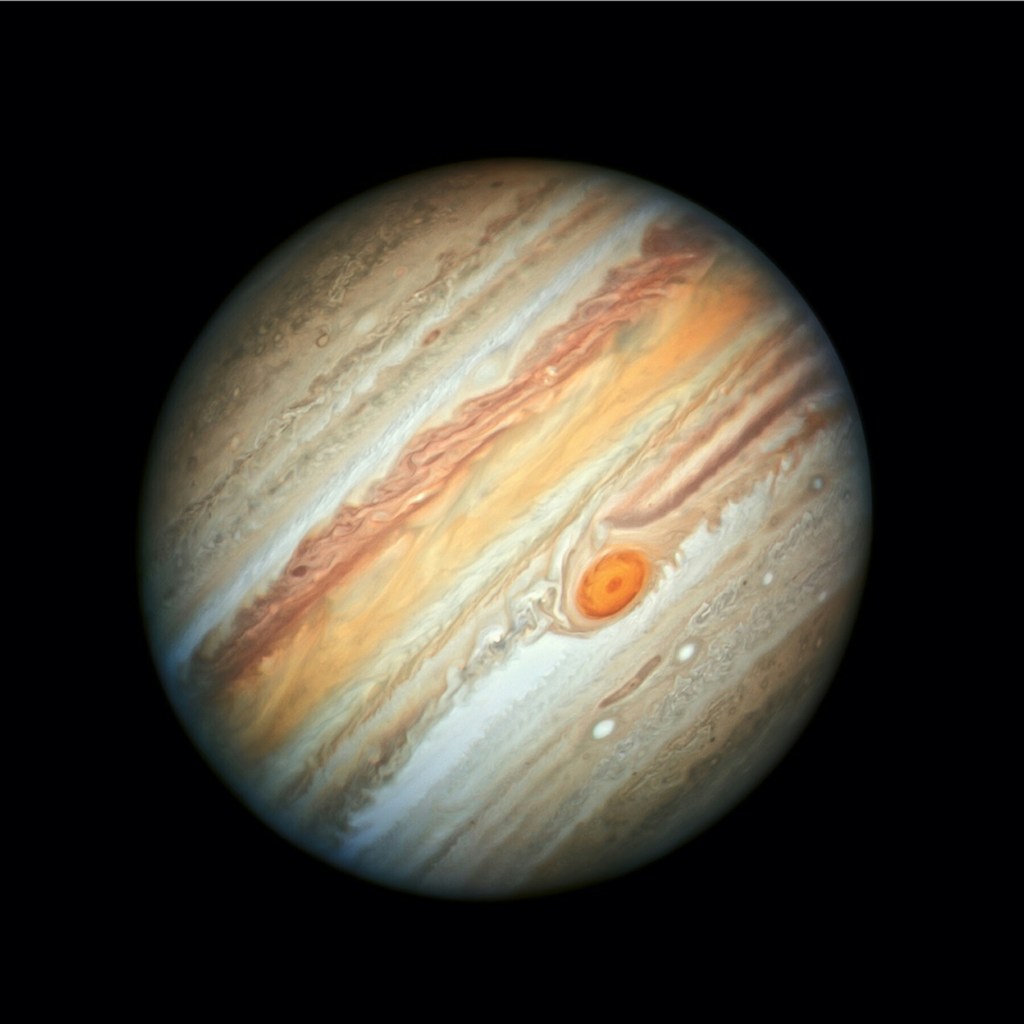
Jupiter is primarily composed of hydrogen with a quarter of its mass being helium, though only about a tenth of the number of molecules are helium. It may also have a rocky core of heavier elements.
Pioneer 10 was the first spacecraft to visit Jupiter, making its closest approach to the planet in December 1973; Pioneer 10 identified plasma in Jupiter’s magnetic field and also found that Jupiter’s magnetic tail is nearly 800 million kilometres long, covering the entire distance to Saturn.
The first spacecraft to orbit Jupiter was the Galileo probe, which entered orbit on December 7, 1995. It orbited the planet for over seven years, conducting multiple flybys of all the Galilean moons and Amalthea. The spacecraft also witnessed the impact of Comet Shoemaker–Levy 9 as it approached Jupiter in 1994, giving a unique vantage point for the event. Its originally designed capacity was limited by the failed deployment of its high-gain radio antenna, although extensive information was still gained about the Jovian system from Galileo.
MASS
Jupiter would need to be about 75 times as massive to fuse hydrogen and become a star, the smallest red dwarf is only about 30 percent larger in radius than Jupiter. Despite this, Jupiter still radiates more heat than it receives from the Sun; the amount of heat produced inside it is similar to the total solar radiation it receives. This additional heat is generated by the Kelvin–Helmholtz mechanism through contraction. This process causes Jupiter to shrink by about 1 mm/yr. When formed, Jupiter was hotter and was about twice its current diameter

 UTTER
UTTER 